5 min read
What Is the 30 Plants a Week Challenge?
Understand the 30 plants a week goal, what foods count, and why plant diversity matters more than perfection.
Read GuideEating30 helps you track 30 different plant-based foods every week — the goal linked by research to a more diverse gut microbiome. Log foods in seconds with quick-tap logging from a database of 500+ plants, barcode scanning, or Siri voice input on iPhone.
Free to download — core plant tracking included
Unlike generic food trackers focused on calories, Eating30 is designed specifically for tracking plant-based food diversity. Simple logging, no overwhelm.
Available as an optional premium feature on supported Apple Intelligence devices. Type a dish name or paste an ingredient list and Eating30 can suggest plant ingredients for faster logging.
Powered by Apple Intelligence, Apple’s built-in AI. It only works on devices that support Apple Intelligence — iPhone 15 Pro, iPhone 16, or newer, plus recent iPad and Mac models. Having other AI apps like ChatGPT installed doesn’t enable it. Not available in the Android app.
Check if your device supports Apple Intelligence ↗Add foods fast with minimal taps or scan barcodes on packaged foods, and use Siri voice input on iPhone. Choose from a database of 500+ plants across fruits, vegetables, grains, legumes, nuts, seeds, herbs, and spices. Barcode scanning is free on iOS and part of Premium on Android.
See how close you are to your weekly 30 plants goal. Track your Eat the Rainbow statistics, view weekly trends, and watch your plant count grow with a clean statistics dashboard.
Earn achievement badges for hitting milestones and building consistency. Set reminders to help make plant tracking a daily habit.
Based on research from the American Gut Project, which found that dietary diversity — particularly plant variety — is associated with greater microbial diversity in the gut.
On iPhone and iPad, your data syncs across your Apple devices with iCloud. On Android, Eating30 supports Android's built-in backup to your Google account, so your journal can be restored when you reinstall or move to a new phone. It does not sync between devices.
Designed for daily use: clean and fast. In Eating30 logging never feels like work.
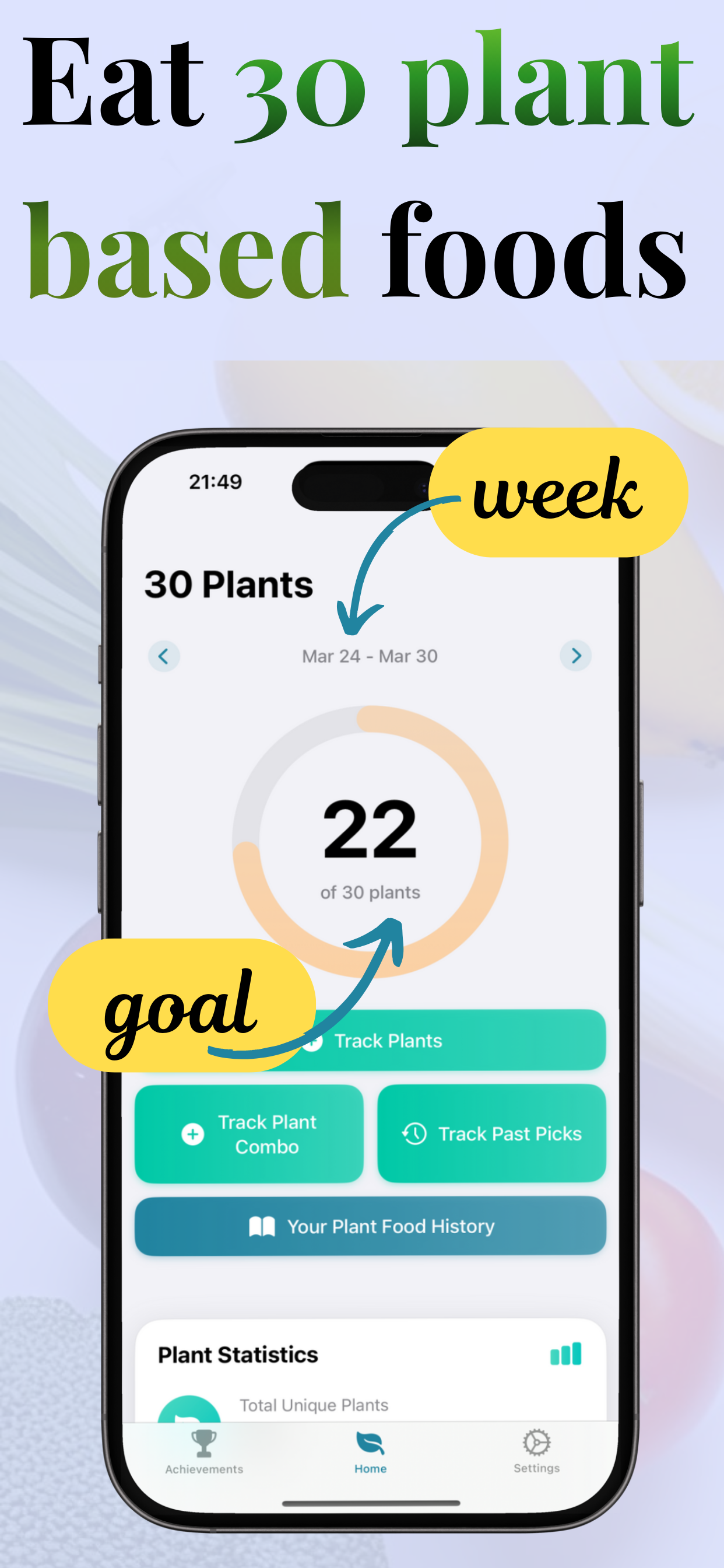
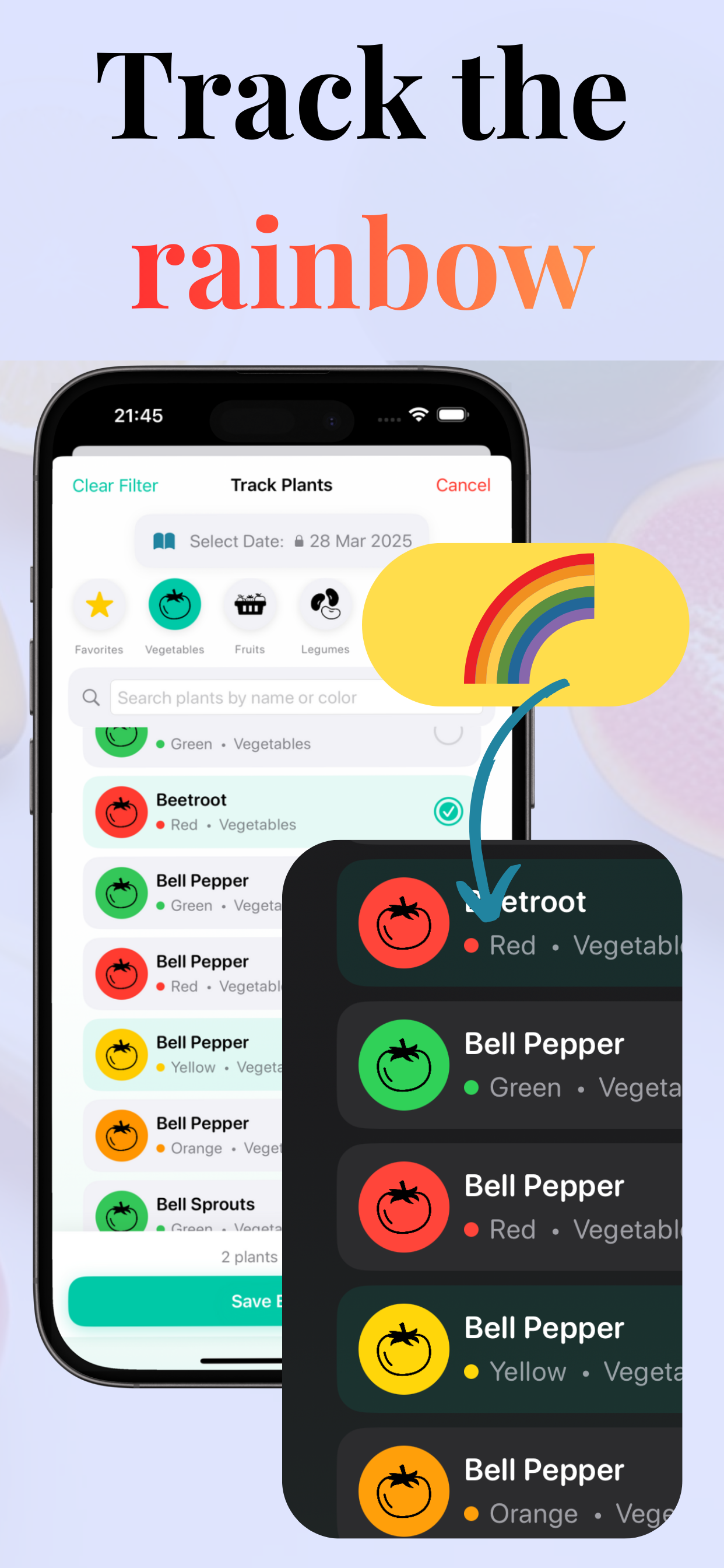
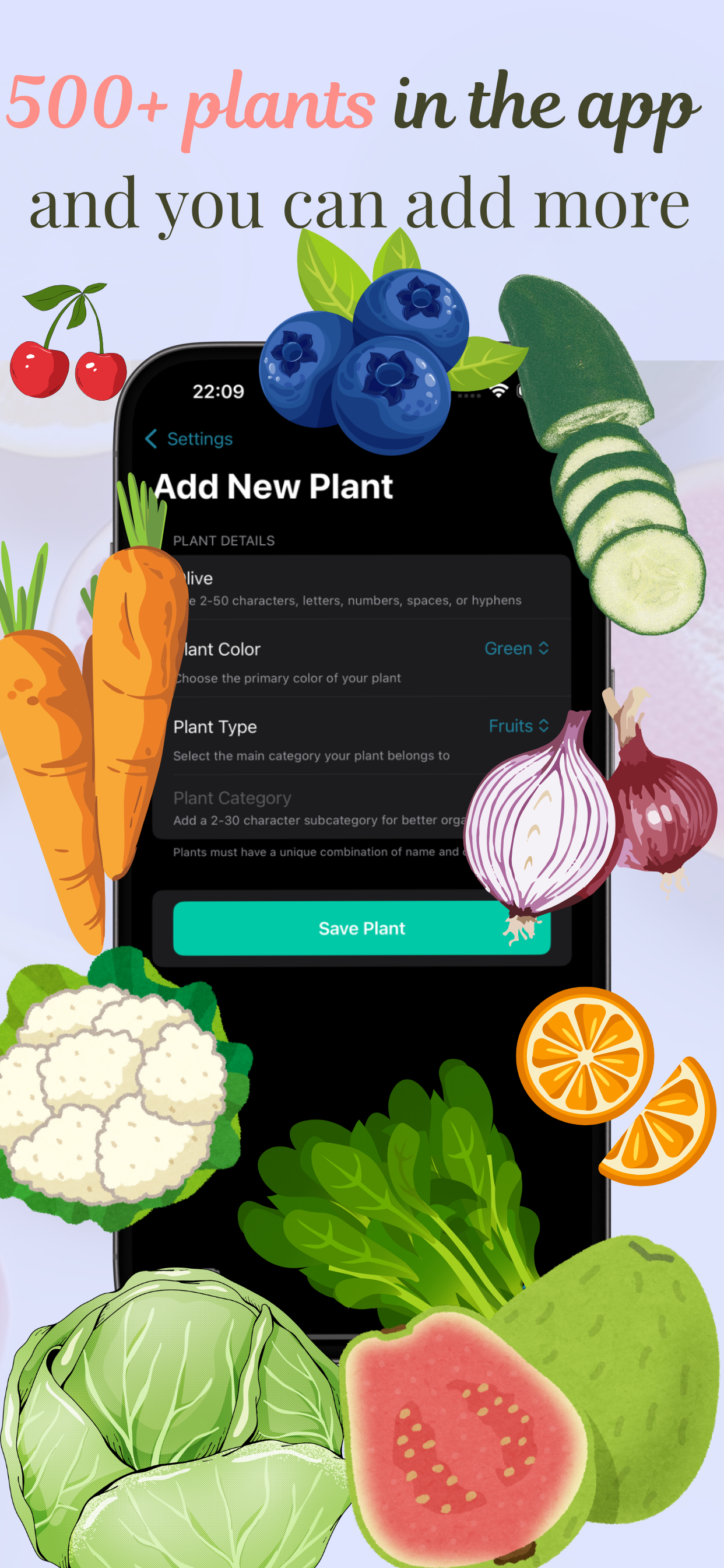
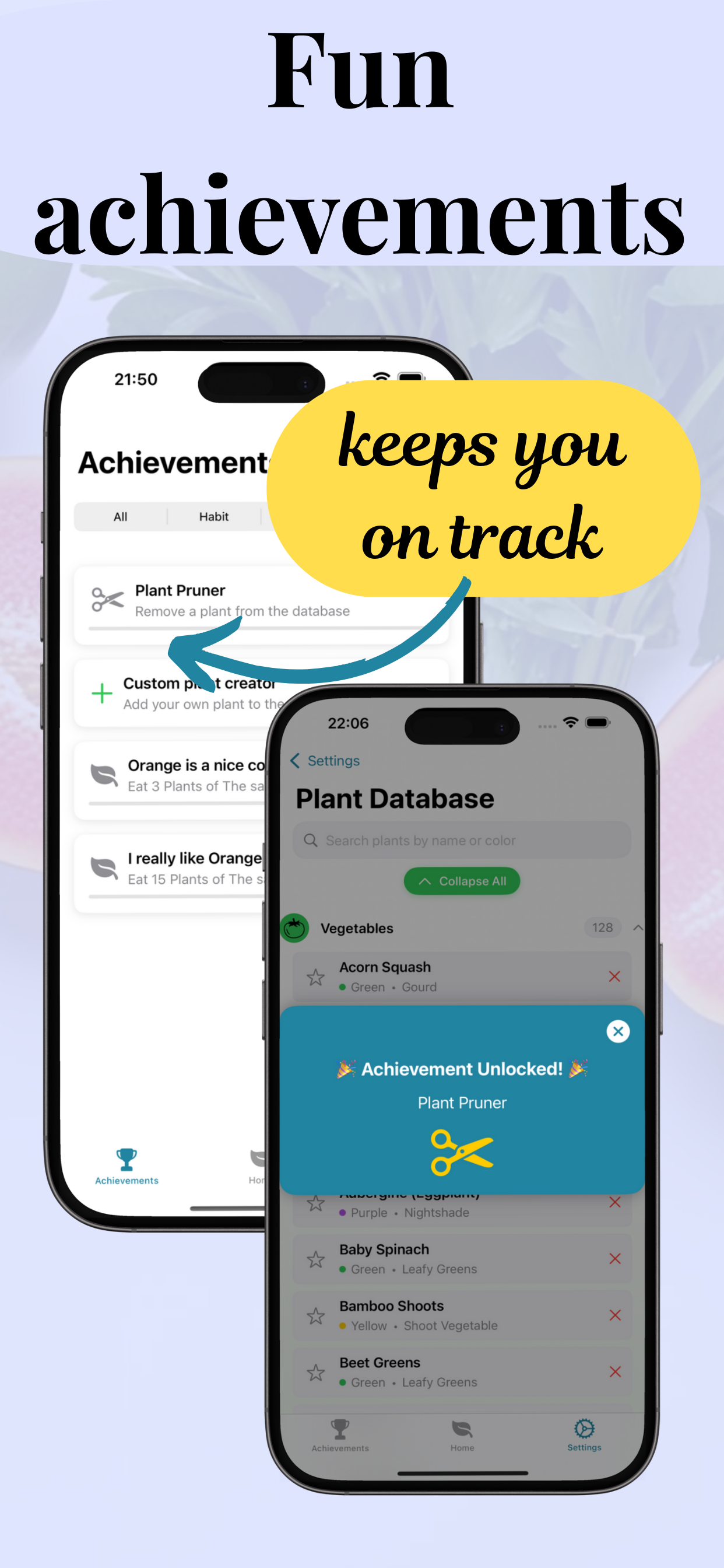
Three simple steps to build the habit of eating 30 different plants per week
Get the Eating30 app free from the App Store or Google Play and begin tracking your plant-based food diversity right away
Track your daily plant-based foods with quick-tap logging from 500+ plants, barcode scanning, or Siri voice input on iPhone
Watch your progress, earn achievements, and explore new plant-based foods to add variety to your diet each week
Optional premium feature · iOS only
Eating30 also includes optional premium AI ingredient search. Type a dish name or paste an ingredient list and the app can suggest plant ingredients for faster logging when Apple Intelligence is available on your device. This feature is not available in the Android app.
The 30 plants a week concept comes from research suggesting that dietary diversity is associated with a more diverse gut microbiome
Research from the American Gut Project found that people who eat 30 or more different plants per week tend to have a more diverse gut microbiome compared to those who eat fewer than 10
Different plant-based foods provide different types of fibre, vitamins, minerals, and phytochemicals. Eating a wider variety means a wider range of nutrients
Eating30 makes tracking plant diversity simple so you can build a consistent habit without calorie counting or complicated food diaries
Track your intake across fruits, vegetables, whole grains, legumes, nuts, seeds, herbs, and spices. Eating30 includes Eat the Rainbow statistics to help you see your colour variety at a glance.
The 30 plants per week concept comes from the American Gut Project — one of the largest citizen science studies of the human microbiome, analysing over 10,000 participants from the United States, United Kingdom, and Australia. The study found that people who ate at least 30 different types of plant-based foods per week had a more diverse gut microbiome compared to those who ate 10 or fewer. Eating30 was designed around this research to make tracking plant diversity simple and accessible.
Original Eating30 guides on 30 plants per week, gut health, and practical ways to build more variety into your week.
5 min read
Understand the 30 plants a week goal, what foods count, and why plant diversity matters more than perfection.
Read Guide6 min read
Not sure whether oats, lentils, herbs, spices, coffee, or different apple varieties count? This guide breaks it down.
Read Guide7 min read
The 30 plants goal came from microbiome research, but what does it actually mean and how strong is the evidence?
Read GuideCommon questions about 30 plants per week, plant diversity, gut health, and the Eating30 app
The 30 plants a week challenge is based on findings from the American Gut Project, one of the largest studies of the human microbiome. The research found that people who eat at least 30 different plant-based foods per week tend to have a more diverse gut microbiome compared to those who eat fewer than 10. Plants include fruits, vegetables, whole grains, legumes, nuts, seeds, herbs, and spices — each distinct type counts as one plant.
Eating30 is a dedicated plant diversity tracker for iOS and Android that makes logging simple. You can add foods with minimal taps or scan barcodes on packaged foods. The app includes a database of 500+ plants, tracks your weekly progress toward 30 different plants, and shows Eat the Rainbow statistics. On iPhone, you can also use Siri voice input, sync across your Apple devices with iCloud, and — on supported Apple Intelligence devices — use optional premium AI ingredient search for dish names and ingredient lists.
Fruits, vegetables, whole grains, legumes, nuts, seeds, herbs, and spices all count. Each distinct type counts as one plant — for example, blueberries and strawberries are two different plants. In Eating30, you can customise the rules to decide whether varieties (like purple vs orange carrots) count separately, and you can add your own plants and categories.
Yes. A plant can be logged as a full plant, a half (½), or a quarter (¼). This follows the popular plant points approach, where herbs, spices, garlic, olive oil, tea, and coffee are usually counted as a quarter, and things like vegetable stock as a half, since they are eaten in much smaller amounts than a serving of beans or broccoli. Fractions add up in Eating30 — four different herbs at a quarter each make one full plant toward your weekly 30 — so small additions still count without inflating your total.
Yes. Eating30 is free to download on iOS and Android, and the core 30-plant tracking experience is free to use, including food logging, weekly progress tracking, and achievements. On iOS, barcode scanning, Siri voice input, and iCloud sync are also free. Optional premium features — such as a full journal with search, prebiotics and polyphenol tracking, and saved plant combos — are available separately. On Android, barcode scanning is part of Premium, and AI ingredient search is available only on iOS.
No. Eating30 is not built around calories or macros. It is a plant diversity tracker designed to help you reach 30 plants per week, build gut-friendly habits, and make your weekly food variety visible.
The American Gut Project, one of the largest studies of the human microbiome, found that dietary diversity — particularly the number of different plant-based foods consumed — was associated with greater microbial diversity in the gut. Different plants provide different types of fibre and nutrients, which may support different beneficial bacteria. Eating30 helps you track this dietary diversity. Note: this information is educational and is not medical advice.
On iOS, yes. Eating30 supports iCloud sync, so your logged foods, progress, and achievements stay up to date across your Apple devices automatically. The Android app does not sync between devices; it uses Android's basic built-in backup to your Google account, which can restore your data when you reinstall the app or set up a new phone. Data does not sync between iOS and Android.
Eating30 includes optional premium on-device AI ingredient search powered by Apple Foundation Models. On supported Apple Intelligence devices, you can type a dish name or paste ingredients, and the app identifies likely plant ingredients and matches them to the Eating30 plant database so you can log them faster. Availability depends on Apple Intelligence support on your device, language, and region. AI ingredient search is available only in the iOS app; the Android app does not include AI features.
The easiest way is to build variety from foods you already eat: rotate beans and grains, add nuts and seeds, count herbs and spices, and spread plant variety across breakfast, lunch, dinner, and snacks. The Eating30 tracker helps by showing your weekly total clearly so small additions are easier to spot.
If you bought a premium feature or subscription through the App Store or Google Play, the store handles billing, cancellations, and refund requests directly. That means refunds are requested through Apple or Google rather than through Eating30. Use Apple billing and subscriptions support on iOS, or the Google Play subscriptions screen on Android, to manage your subscription or request a refund.
Download Eating30 and start tracking 30 different plants a week. Simple logging, barcode scanning, and a database of 500+ plants — all in one focused app for iOS and Android.
Available on iOS and Android — Free to Download
Disclaimer: This app provides educational and habit-tracking content and is not a substitute for medical advice. If you have health concerns, dietary restrictions, or a medical condition, please consult a qualified healthcare professional.