
Who came up with 30 plants a week?
The number is usually traced back to the American Gut Project, a large citizen-science study of the gut microbiome. In a paper published in 2018, the researchers grouped thousands of participants by how many different plant types they reported eating per week. The two groups people quote are more than 30 and fewer than 10, and the people eating more than 30 had a more diverse gut microbiome.
That is the origin. Thirty was never designed as a diet plan. It was a way of slicing survey data that happened to be very easy to remember, which is why it works as a target rather than a medical prescription.
Why diversity matters more than a single superfood
Different plants bring different fibers, resistant starches and polyphenols, and gut bacteria do not all feed on the same things. That is why researchers look at variety rather than at one ingredient.
This is one reason the 30 plants idea resonates with people who are tired of nutrition advice built around one magic ingredient. Variety is more realistic, and it better matches the way people actually eat across a week.
Fiber and polyphenols are part of the story
Plant diversity is not only about raw vegetable intake. Whole grains, legumes, nuts, seeds, herbs and spices bring their own fibers and plant compounds too.
A bowl with beans, barley, parsley, red cabbage, carrots and pumpkin seeds is six different plants, while a meal that looks healthy can rely on only one or two.
What the evidence can and cannot prove
Much of the public conversation rests on an association found in survey data. It is not proof that eating exactly 30 plants will produce a particular result in any one person.
Your gut microbiome is shaped by more than diet alone. Sleep, stress, exercise, medications, health conditions and baseline eating habits all matter too. The 30 plants framework is helpful, but it should not be oversold as a cure or a shortcut.
How to treat the number
As a target, not a threshold. Nothing switches on at plant 30, and the number is not a medical recommendation. It is a finish line for a habit many people find worthwhile on its own: eating a wider range of foods than the same eight ingredients on rotation.
Since 2018, books, podcasts and food writers have run with the idea, and the rules have picked up local variations. Some people count herbs as a quarter. Some count red and green peppers separately. Some leave out white rice. None of these versions is official, so pick one you will stick to.
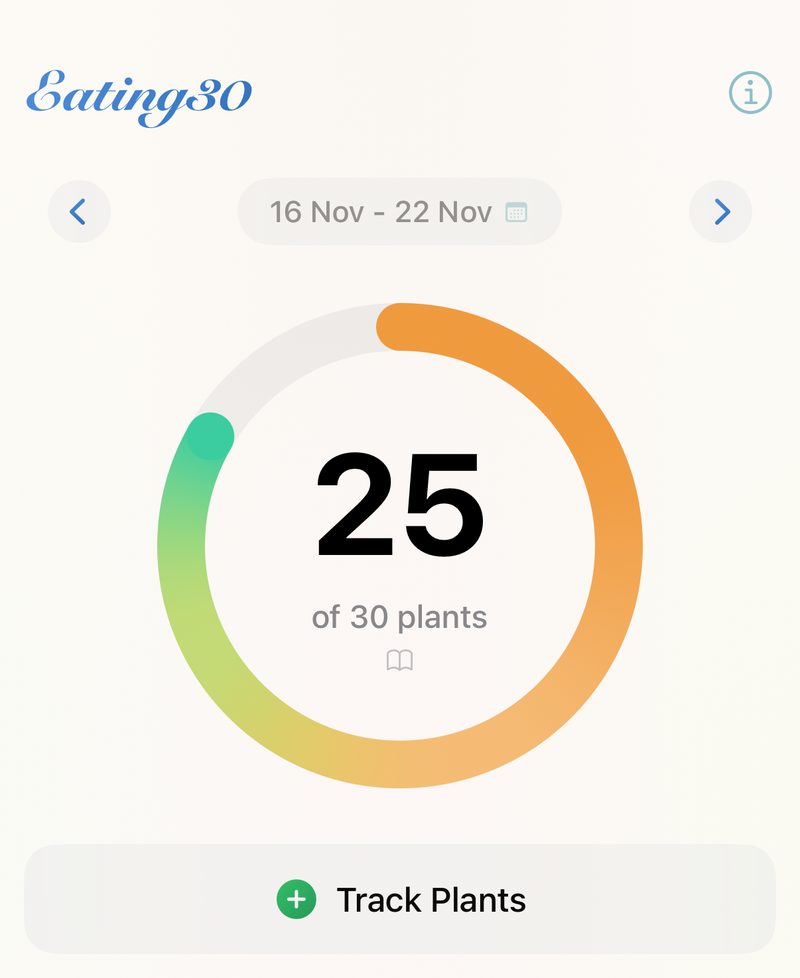
- Each new week starts the count again, and earlier weeks stay in your history.
- The number is this week's count: a guide, not a test.
The practical takeaway
The most defensible takeaway is modest: 30 is a useful, memorable target for eating a wider range of plant foods. If your current diet is limited, the next small step already counts.
Eating30 counts that variety and makes no health promises. It shows how many different plants you have eaten this week and which color groups you have covered. What you make of that is up to you, and if you have a medical condition, your doctor's view matters more than any app's.