
Color is a practical shortcut
Eating the rainbow is helpful because it turns an abstract nutrition goal into something visual. If your plate includes multiple colors, there is a good chance it also includes more variety.
That matters for people trying to reach 30 plants per week because color nudges you toward different fruits, vegetables, herbs, and grains without needing a spreadsheet.
Different colors usually mean different compounds
Red berries, orange carrots, green leafy vegetables, purple cabbage, and white onions are not interchangeable. They tend to bring different fibers, pigments, and phytochemicals to the diet.
You do not need to memorize every compound. The useful habit is simply to stop relying on one narrow color range.
It is not just about fruit and vegetables
Color variety also includes beans, grains, herbs, spices, and seeds. Black beans, red lentils, green pistachios, golden flax, brown oats, and fresh herbs all widen the picture.
So you can build a more colorful and more diverse week even when your meals are simple.
How to do it without overthinking
A practical approach is to add one more color to whatever you already eat. Put berries on oats, herbs on eggs, cabbage in wraps, or seeds on soup. Choose mixed vegetables instead of one vegetable. Rotate fruit through the week instead of buying the same two items.
You do not need perfect rainbow balance every day. Across a week, a wider spread of colors usually means a wider spread of plants.
Why it fits the Eating30 approach
Eating30 is built around visible variety, and color is one of the easiest ways to notice that variety. If your weekly log looks monochrome, you probably have room to broaden your plant intake.
The five color groups
Most versions of eat the rainbow use five color groups. These are the ones Eating30 uses. The white, brown and gray group surprises people: beige food gets a bad name, but garlic, cauliflower, mushrooms, nuts and most whole grains live there.
- Green: spinach, broccoli, peas, kiwi, parsley
- Red and pink: tomatoes, strawberries, red peppers, radishes, kidney beans
- Orange and yellow: carrots, butternut squash, sweet potato, lemons, corn
- Blue, purple and black: blueberries, eggplant, red cabbage, black beans, blackberries
- White, brown and gray: garlic, onions, mushrooms, oats, chickpeas
How Eating30 shows the colors
Eating30 has an Eat the Rainbow card on the home screen. It is a rainbow of five arcs, one per color group, and each arc lights up when you log a plant of that color. You can look at the whole week or tap a single day.
Tap an arc and the card lists the plants that gave you that color. If purple is still dark on Thursday, you know what is missing and can do something about it on Friday. Getting all five colors in a week makes a good second goal once 30 starts to feel routine.
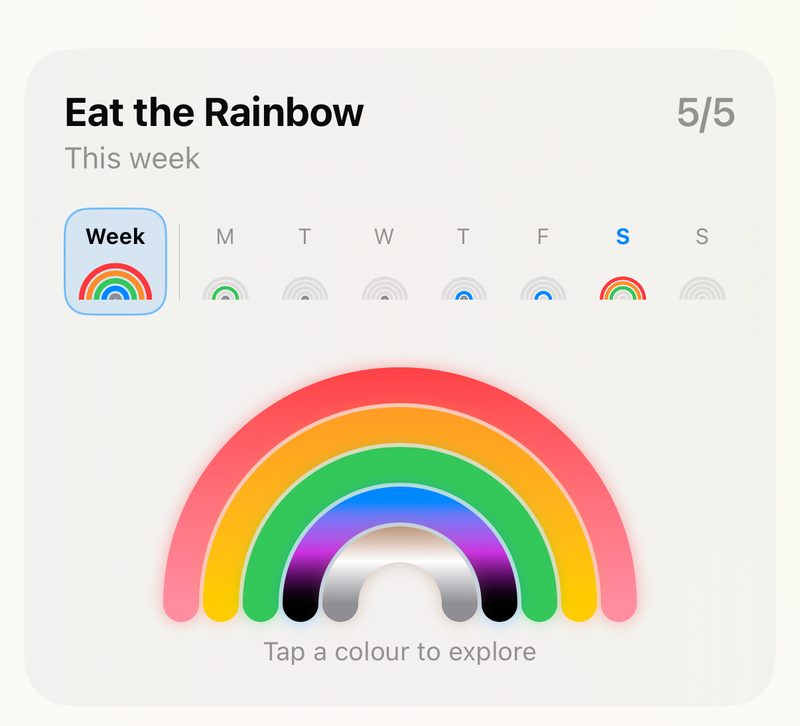
- Look at the whole week, or tap a single day.
- Each arc is a color group and lights up when you log a plant of that color.