
What a food diary is for
A food diary is a record of what you ate. That is all it has to be. Most of its value comes from writing things down at all: you notice the third biscuit, the week of identical lunches, the fruit bowl nobody touched.
Research on self-monitoring points the same way. A 2011 systematic review of studies in weight-loss programmes found a consistent link between keeping food records and reaching the goal people had set, and the more consistently people recorded, the better they tended to do. This guide is not about weight, but the lesson carries over: a habit you never notice is hard to change.
Calories are not the only thing worth writing down
Calorie counting asks for a number for every food, which means weighing, reading labels and guessing at restaurant meals. Some people like that precision. Many stop after a few weeks because the diary has turned into a second job.
A diary without numbers asks a different question: what did I eat, and what does my week look like? You give up precision and get a record you will actually keep. For building a habit, that is usually the better trade.
Keep it small enough to keep going
Habits form through repetition in a steady context. In a 2010 study at University College London, volunteers repeated one simple daily action, such as eating a piece of fruit with lunch. It took a median of 66 days before the action felt automatic, with a wide range from person to person, and missing a single day did not undo the progress.
So the most useful diary is the one that takes seconds. Log at the same moment each day, keep it to a few words, and look back once a week instead of judging every meal.
- Log at a fixed moment, like after dinner
- Write down foods, not grams
- Look back once a week, not after every meal
- Miss a day without starting over
Counting plants instead of calories
One simple thing a diary can track is variety: how many different plant foods you ate this week. That turns a vague aim like eating better into a number that only goes up as you add foods. It is the idea behind the 30 plants a week goal, which comes from a 2018 American Gut Project paper comparing people who ate more than 30 different plants a week with people who ate fewer than 10.
A plant diary also shows the gaps quickly. Many people find that their weekdays rely on the same eight or ten plants, and that the easiest additions are herbs, seeds and one more kind of bean.
How Eating30 keeps the diary
Eating30 is a diary of the plants you eat. It has no calories, grams or macros. You tap the plants you ate from a list of more than 350, and the ring for the week fills up toward 30.
It counts the way most plant counters do. Each different plant counts once per week, however often you eat it. Any plant can be logged as a whole, a half or a quarter, and many people log herbs, spices, garlic, tea and coffee as a quarter, so four different herbs make one plant. You choose whether color varieties such as red and white cabbage count separately, and on which day your week starts.
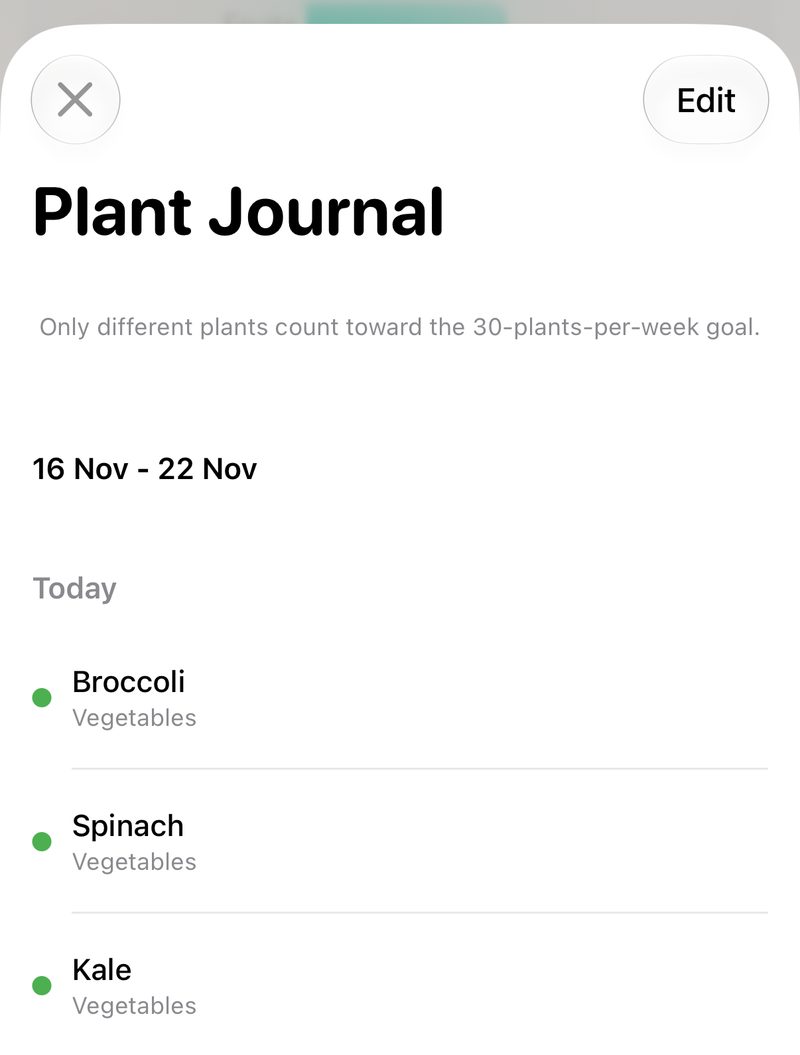
- The journal goes week by week and day by day, with no calories and no grams.
- Every plant you ate today, with its color and group.
Sources
- Burke, Wang and Sevick (2011), Self-Monitoring in Weight Loss: A Systematic Review of the Literature. Journal of the American Dietetic Association
- Lally et al. (2010), How are habits formed: Modelling habit formation in the real world. European Journal of Social Psychology
- McDonald et al. (2018), American Gut: an Open Platform for Citizen Science Microbiome Research. mSystems