
Vegetarian does not automatically mean varied
A vegetarian diet is often assumed to be varied and balanced. It can be, but it can also narrow quickly when meals lean on the same cheese, bread, pasta, eggs and a few familiar vegetables.
So healthy eating as a vegetarian is not only about what you leave out. It is also about how much range there is in what you do eat.
What official advice says to watch
The Academy of Nutrition and Dietetics, the largest organisation of dietitians in the US, states that appropriately planned vegetarian and vegan diets are nutritionally adequate at every stage of life. The important words are appropriately planned.
The NHS advice for vegetarians is to follow the same balanced pattern as everyone else and to make sure of a few nutrients that are easier to miss without meat or fish, including iron, vitamin B12 and omega-3 fats. Eggs and dairy cover B12 for many vegetarians. Beans, lentils, dried fruit, dark green vegetables and wholemeal bread bring iron, and walnuts, flaxseed, chia and pumpkin seeds bring omega-3.
Think in meal building blocks
A practical way to plan is to build meals from a few repeating parts: a protein-rich plant food, a grain or other starch, several vegetables, and extras like seeds, herbs or spices.
That gives enough structure to make meals easy while leaving room to rotate what goes into each part.
- Legumes such as lentils, chickpeas, beans, peas or tofu
- Whole grains such as oats, barley, buckwheat or brown rice
- A wider range of vegetables across the week
- Nuts, seeds, herbs and spices for extra variety
Where the variety comes from
Rotation does most of the work. If lentils, chickpeas, kidney beans and black beans all appear in one week, that is four plants from the protein part of the plate alone. Swap the usual pasta for barley or buckwheat now and then, add a seed mix to breakfast, and you can pass ten before counting a single vegetable.
None of this has to be perfect every week. A week that is a little more varied than the last one is the direction that matters.
How Eating30 counts it
Eating30 counts plants for anyone, vegetarian or not, and it is good at showing when a week leans on the same few foods. Each different plant counts once per week however often you eat it, so the fifth pasta night adds nothing new, while a bean you haven't had this week does.
Herbs, spices and garlic can be logged as a quarter, and four quarters make one plant. Cheese and eggs aren't plants, so they don't count toward the 30. The number only shows how much of your week comes from different plants, which is exactly the part that tends to shrink on a busy week.
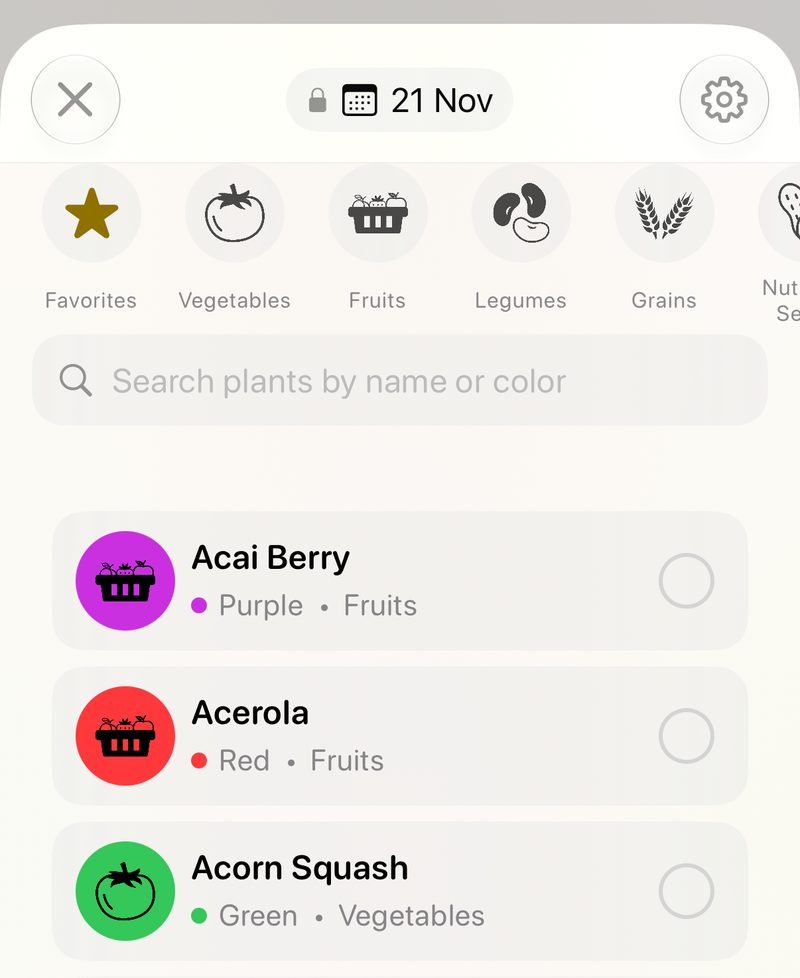
- The plant list is grouped: vegetables, fruits, legumes, grains and more.
- Or search by name or color.