
Why people burn out on tracking
Many people want to eat more plant-based food without weighing, scanning and optimizing every bite. Detailed tracking adds friction quickly, and once it becomes a chore the habit tends to collapse.
So the better question is usually not how to track everything, but how to track just enough to notice patterns and improve.
What plant-based can mean
Plant-based covers a range, from vegan to mostly plants with some meat, fish or dairy. What these patterns share is that most of the plate comes from plants. Leaving out animal products is only half of it. The other half is how wide a range of whole plant foods you actually rely on.
If you eat no animal products at all, the NHS advises getting some nutrients from fortified foods or supplements, including vitamin B12, vitamin D, iodine, selenium and calcium. That is one of the few places where a plant-based diet really does need a plan.
A few signals instead of a spreadsheet
For a lighter approach, a handful of signals tell you most of what you need to know, and none of them needs a kitchen scale.
They are easy to check at the end of a week. A week built around beans, grains, vegetables, nuts, seeds, fruit and herbs usually does well on all of them.
- How many different plants you ate this week
- Whether beans, lentils or other legumes showed up several times
- Whether most days included a whole grain
- Whether your meals were filling enough to keep eating them
Why lighter tracking lasts longer
A system that takes seconds is one you keep using. Habit research supports keeping it simple: in a 2010 study at University College London, simple daily actions took a median of 66 days to become automatic, and an occasional missed day made little difference. A heavier routine asks for more every day, which makes it easier to drop before it ever sticks.
When logging is quick, you collect enough weeks to see real patterns, and that is what makes small, realistic changes possible.
How Eating30 counts it
Eating30 tracks one concrete signal: how many different plants you eat in a week. It doesn't count calories or macros, and it isn't trying to control your whole diet. You tap the plants you ate, and the weekly ring fills up toward 30.
Each different plant counts once per week. Any plant can be logged as a whole, a half or a quarter, so herbs, spices, garlic, tea and coffee can go in as a quarter and four of them make one plant. You can choose whether color varieties such as red and white cabbage count separately, and add a plant of your own if one is missing.
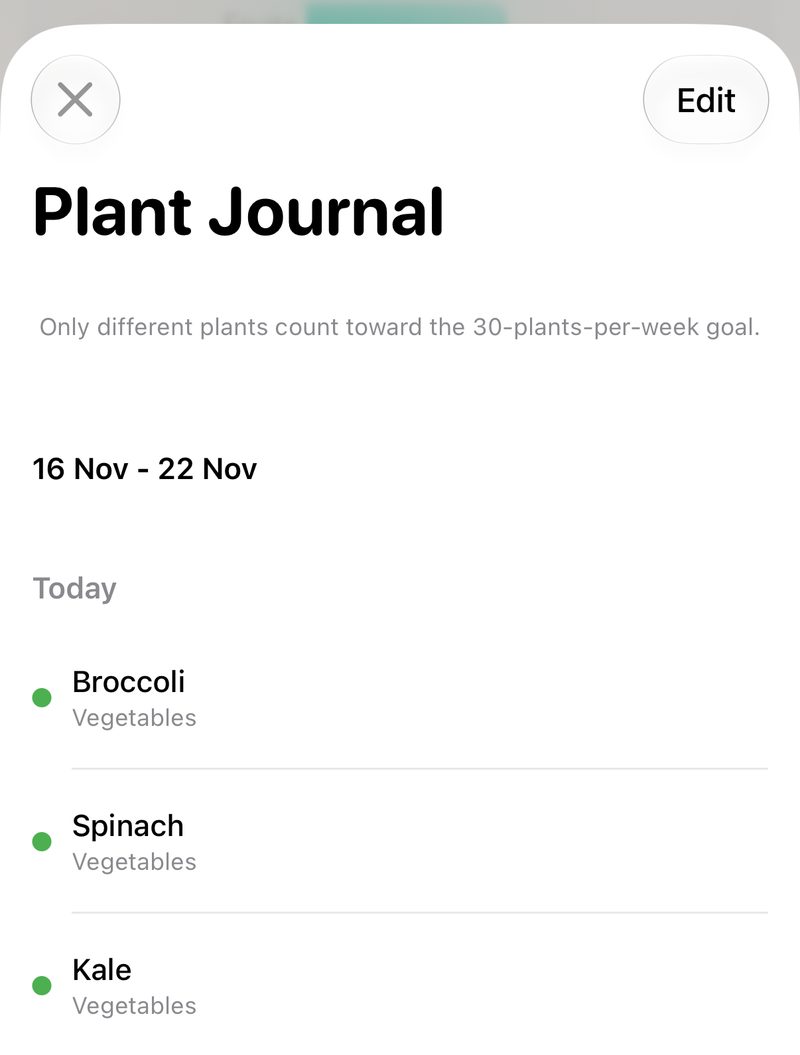
- Just the plants you ate: no grams and no calories.
Sources
- NHS: The vegan diet
- Melina, Craig and Levin (2016), Position of the Academy of Nutrition and Dietetics: Vegetarian Diets. Journal of the Academy of Nutrition and Dietetics
- Lally et al. (2010), How are habits formed: Modelling habit formation in the real world. European Journal of Social Psychology
- McDonald et al. (2018), American Gut: an Open Platform for Citizen Science Microbiome Research. mSystems