
What the idea actually means
30 plants a week means eating 30 different plant foods over seven days. Not 30 portions: 30 different kinds. Instead of counting calories or macros, it asks a simpler question: how many different plant foods did you eat this week?
Each plant counts once per week, however often you eat it. Five bananas is one plant. A banana, a pear and some blueberries is three.
Nothing is banned. It is one of the few food rules about adding rather than cutting, which is a big part of why people stick with it.
Why people connect it to gut health
The idea came out of microbiome research that looked at plant variety. Different plant foods bring different fibers, resistant starches and polyphenols, so eating a wider range of them is what researchers were interested in.
That does not mean you need a perfect score every week. The useful part of the idea is that it encourages variety, and variety is often one of the first things that disappears when meals become rushed or repetitive.
Not just vegetables: what counts toward your weekly total
People sometimes call it 30 vegetables a week, but vegetables are only part of it. Fruit counts too, and so do the things people forget: beans, lentils, whole grains, nuts, seeds, herbs and spices. Oats at breakfast, a handful of walnuts, chickpeas in a salad and cumin in dinner are four plants already.
Some people also count different varieties separately, such as red cabbage and white cabbage or green apples and red apples. The exact rules vary, but the bigger goal is consistency rather than arguing over tiny edge cases.
- Fruit and vegetables
- Beans, lentils, peas, and other legumes
- Whole grains such as oats, barley, brown rice, and quinoa
- Nuts and seeds
- Herbs and spices
How many plants a week? Why the number is 30
Thirty is not a magical line where everything changes overnight. It comes from a 2018 American Gut Project paper that compared people who ate more than 30 different plants a week with people who ate fewer than 10, and it stuck because it is easy to remember.
For some people, 30 plants a week is easy once they start counting. For others, the first real win is moving from 8 or 10 familiar foods to 15 or 20. That kind of progress still counts.
How to keep count
You can tally on paper, in a notes app, or with an app built for it. If you like paper, there is a free printable 30 plants a week checklist on this site.
Eating30 is the app we make for it. You tap the plants you ate, a circle fills up toward 30, and the count starts again when your new week begins. Herbs and spices can go in as a quarter or a half, which is how a lot of people like to count them.
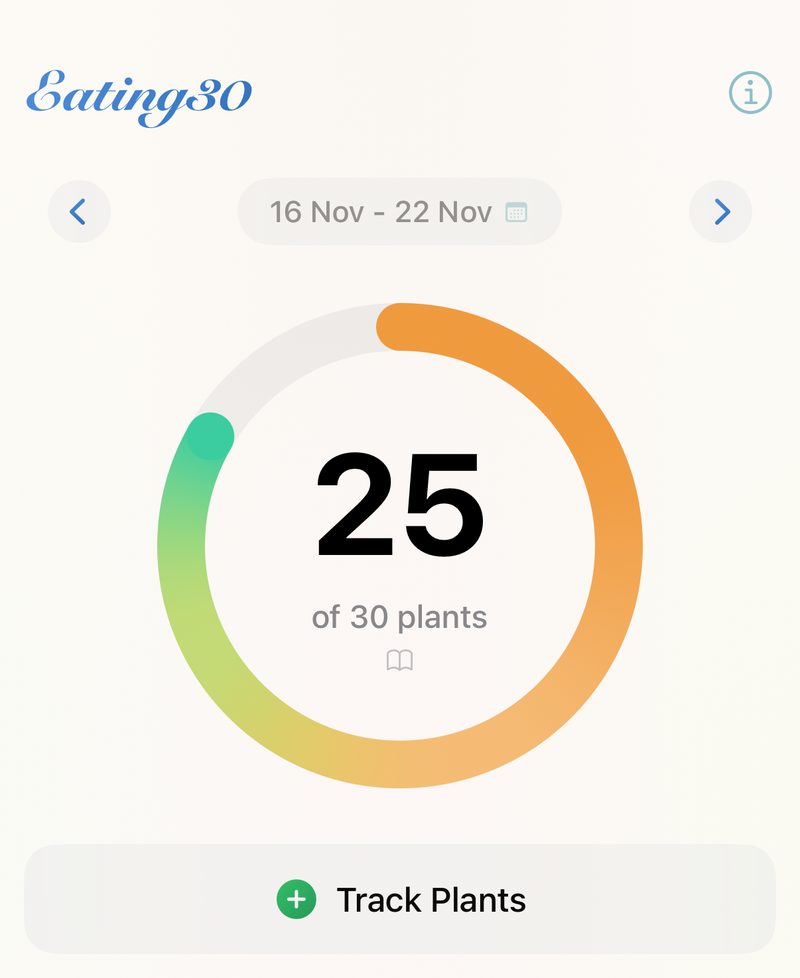
- The week starts on the day you choose. The arrows go to earlier weeks.
- The circle counts the different plants you have eaten this week, out of 30.
- Track Plants opens the list: tap what you ate.
A practical way to start
If 30 sounds like a lot, count an ordinary week first and see where you land. Getting from there to 30 is usually herbs, seeds and one more tin of beans, not a new diet.
A handful of seeds on breakfast, beans at lunch, herbs in dinner and fruit as a snack all add up faster than people expect.
30 plants a week vs 5 a day
The two measure different things, which is why you can hit one and miss the other. 5 a day counts portions of fruit and vegetables, so it is about amount. 30 plants a week counts types, so it is about variety. It also casts a wider net, because whole grains, nuts, seeds, herbs and spices mostly do not feature in 5 a day.
Take a Monday of porridge with a banana, a cheese and tomato sandwich, then spaghetti with a tomato, onion and garlic sauce. By portions that is roughly three. By plant count it is oats, banana, wheat, tomato, onion and garlic, which is six plants. Eat that menu every day and you are still on six on Sunday night.
The two are not rivals. Some people treat 5 a day as the daily habit and the plant count as the weekly variety check.