
Start with the obvious groups
The easiest way to think about plant counting is to start with the major groups: fruits, vegetables, legumes, whole grains, nuts, seeds, herbs, and spices. If a food clearly comes from a plant and you use it as part of a real meal or snack, it often counts.
That is why oats, lentils, pumpkin seeds, parsley, apples, and broccoli all make sense as separate entries in a weekly plant total.
Do herbs and spices count?
Yes, many people count them, because they still contribute plant diversity even when the amount is small. A pinch of cumin is not nutritionally identical to a bowl of lentils, but it still broadens the range of plant compounds in your diet.
Some tracking systems give herbs and spices fractional values while others count them fully. The exact rule matters less than using the same rule consistently.
Most people use a few quick rules:
- Dried counts: dried oregano is still oregano.
- Fresh and dried of the same herb are one plant: fresh basil on Monday and dried basil on Friday is still one basil.
- Black pepper counts, because it is a dried berry.
- Salt does not count, because it is a mineral.
- Blends count by what is in them. Herbes de Provence is usually thyme, rosemary, oregano, marjoram and savory, so check the jar.
What about grains, beans, nuts, and seeds?
These are often the categories people forget. Brown rice, quinoa, chickpeas, black beans, almonds, walnuts, flaxseed, and sunflower seeds all help build variety.
That means someone who thinks they only eat a few plants may already be eating more than they realize once they start counting breakfast grains, lunch legumes, and small toppings.
Do different varieties count separately?
Many people treat clearly different varieties as separate plants, especially when they differ in color, type, or nutrient profile. Red kidney beans and chickpeas are obviously different. Strawberries and raspberries are different. Purple carrots and orange carrots may or may not be counted separately depending on your rules.
The practical answer is to choose a rule you can actually stick with. A tracker is most helpful when it reduces friction, not when it turns every grocery item into a debate.
Red and green apples are the usual test case. On the strict view they are the same species, so they are one plant, like red and white onions or red, yellow and green peppers. On the generous view, different colors of the same plant have different pigments, so they count separately.
Eating30 has a switch for this in Journal Settings: "Treat same plants with different colors as one". It is on by default, so red and green apples are one plant. Switch it off and color varieties count separately, and lentils alone can be four plants: brown, red, green and black. The switch changes your weekly count, not what you have logged.
Edge cases are less important than consistency
Questions like coffee, cocoa, tea, or extra virgin olive oil come up often. Some people include them as fractional plant points and others do not. Either approach can work if you stay consistent.
How much do you need to eat for it to count?
There is no official minimum. Most people count a normal portion, or anything you can actually see on the plate, as one plant. A pinch of a spice or a sprinkle of seeds is where the quarter comes in, which is how plant points work.
Eating more of the same plant never adds a second count. A big bowl of lentils on Monday and another on Thursday is still one plant for the week. If you are unsure about something small, pick a rule and keep to it: the weekly total only tells you something if you count the same way every week.
What are plant points? Why a pinch of oregano is a quarter
Plant points is what many people call the 30 plants count: one different plant, one point. A common convention gives herbs and spices a quarter of a point, because a pinch of dried oregano does not sit on the plate the way a bowl of lentils does. Some people do the same for anything they ate only a little of, such as a few sesame seeds on top.
Not everyone counts this way. Some count a herb in full only when it is fresh and there is a decent handful of it. No governing body sets these rules.
Eating30 follows the same convention. In Track Plants, each tap on a plant moves through the options: the first tap is a full plant, then a quarter, then a half, and one more tap clears it. Quarters add up. Cumin, coriander, turmeric and chili at a quarter each make one point, and a quarter of oregano on four days of the same week makes one full oregano, never more than that.
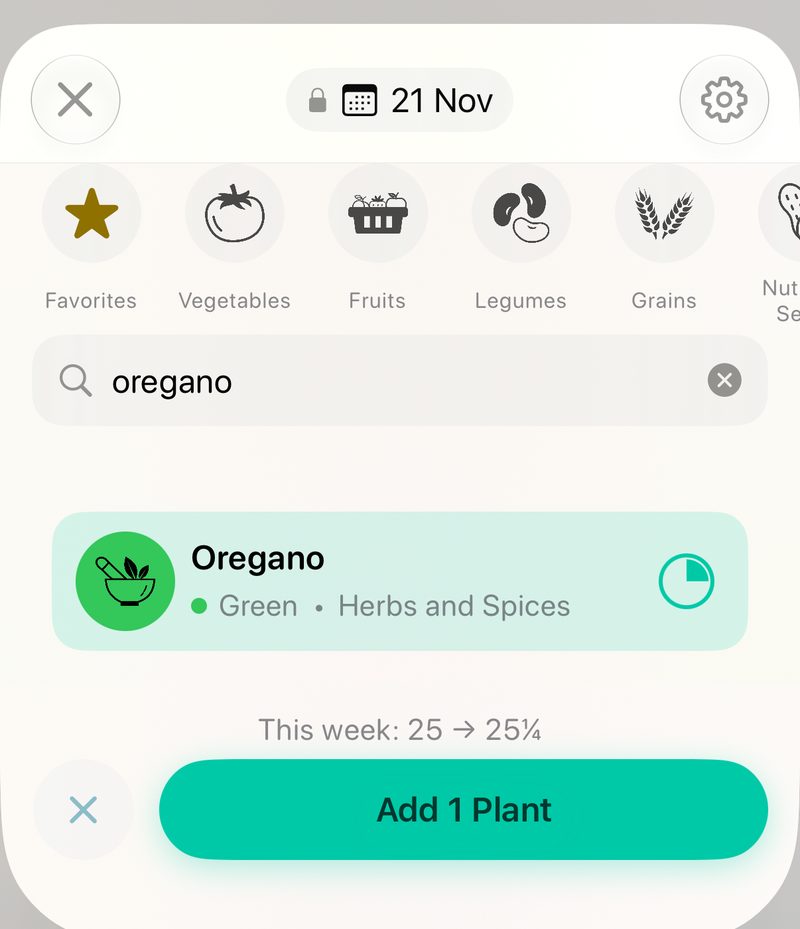
- Tap a plant once to count it whole. Tap again for a quarter, shown as a small pie, again for a half, and a fourth time to take it off.
- The line above the button shows your new total for the week, quarters included.
Does coffee count?
Most people say yes. Coffee beans are the seeds of the coffee plant, so coffee comes from a plant. It counts once a week like everything else: Monday's cup gets the point, and the other twenty cups do not move the number.
Some people leave drinks out, on the grounds that a drink made from a plant is not the same as eating the plant. That is a reasonable rule too. A common middle way is to count coffee as a quarter, the way many people count spices. Decaf, instant and espresso are all the same plant. In Eating30, coffee is listed as Coffee Beans under Nuts and Seeds.
Does tea count?
Yes for most people, with one catch. Green, black and white tea all come from the same plant, Camellia sinensis. The difference is how the leaves are processed, so by the strict rule a week with all three is one plant, not three.
Herbal teas are different plants. Peppermint tea is peppermint and chamomile tea is chamomile, and each counts on its own. Many people log a herbal tea as a quarter, because a tea bag holds a small amount of plant. If a tea you drink is missing from Eating30's list, you can add it as a plant of your own.
Does dark chocolate count?
Mostly, yes. Chocolate is made from cacao beans, the seeds of the cacao tree, so dark chocolate, cocoa powder and cacao nibs all come from the same plant. It counts once a week: a square on Monday counts, and the rest of the bar adds nothing.
A lot of people only count chocolate with a high cocoa content, on the basis that milk chocolate is mostly sugar and milk. That is a personal rule, not an official one. Some count it as a quarter, like a spice. A bar with almonds or hazelnuts has a second plant in it, which counts as well.
Does olive oil count?
Olives count for everyone. Olive oil is where people disagree. One camp counts no oils at all, because an oil is an extract and most of the olive has been left behind. The other camp makes an exception for extra virgin olive oil, often as a quarter point, and skips refined oils such as sunflower oil.
If you do count it, olive oil comes from the same plant as olives, so olives on Monday and olive oil on Wednesday do not make two. Eating30 lists olives but not olive oil. The simplest way is to log Olive when you use the oil.
Do smoothies and juice count?
Smoothies, yes. A smoothie is the whole plant, blended, so everything you put in counts. Banana, spinach, frozen berries, oats and a spoonful of flaxseed is five plants.
Juice is debated, because pressing a fruit leaves much of it behind. Some people do not count juice at all, and others count it as a quarter. If you count it, count the plant: orange juice is orange, and it adds nothing if you have already eaten an orange this week. With shop-bought smoothies, check the bottle. Plenty of green ones are mostly apple and banana juice.
Do mushrooms count?
Technically, no. Mushrooms are fungi, a separate kingdom from plants. In practice, nearly every version of the 30 plants challenge counts them. They are eaten like vegetables and sit next to the vegetables in the shop.
Different kinds generally count separately. Button, shiitake, oyster and enoki are different species, so a pack of mixed mushrooms can be three or four plants on its own. One catch: button, chestnut (cremini) and portobello are the same species at different stages, so a strict counter treats them as one. Eating30 lists them separately because people search for them by name, and mushrooms have a category of their own in the app.
Does seaweed count?
Yes. Most seaweeds are algae, not plants, much as mushrooms are fungi, and people count them all the same. Most count seaweed once whatever form it comes in: nori on sushi, wakame in miso soup, kelp, kombu or seaweed snacks.
Seaweed was not in Eating30's original plant list. It was added in autumn 2026, after 23 different people had each created it as a custom plant.
Do potatoes count?
Yes. The doubt comes from 5 a day. In the UK's 5 a day guidance potatoes do not count, because they are treated as a starchy food alongside bread and rice. But 30 plants a week is a count of different plants, not of portions, and a potato is a plant. Fries, mash, roast and baked potatoes are all the same one.
Sweet potato is a different plant and counts separately. So do yam and cassava. Potatoes also come in white, yellow and purple, and whether those count once or several times depends on your rule for color varieties.
Do garlic and onions count?
Yes, and they are among the most forgotten plants in people's logs, because they go into everything. Onion, garlic, leek, shallot, spring onion and chives are different plants in most people's rules.
Garlic is the one people argue about. A single clove in a big pot of stew feels like a spice, and a whole roasted bulb feels like a vegetable. Some count garlic as a quarter. Others count it as a full plant because they eat it most days. Onions are almost always a full plant. The easiest moment to log them is along with the main dish: the chili, then the onion and garlic that went into it.
Do nuts and seeds count?
Yes, and each kind counts on its own, which makes nuts and seeds the quickest way to move your number. A mixed seed bag with sunflower, pumpkin, flax and sesame is four plants in one spoonful. A bag of mixed nuts can be five or six.
Nut butters count as the nut: peanut butter is peanuts, almond butter is almonds. Peanuts are botanically legumes, so count them once, whichever group you file them in. Seeds used as spices count too, such as cumin, coriander, fennel and mustard seeds.
Do bread, pasta and rice count?
They count, but for less than people hope. Bread, pasta, couscous, bulgur and most crackers are made from wheat, and wheat is one plant. A week of toast, sandwiches, pasta and couscous is still one grain.
Grains add more when they are different grains, because each one counts on its own: oats, rye, barley, spelt, buckwheat, quinoa, millet. A seeded rye loaf, a barley risotto and porridge in one week is three grains, plus whatever seeds were in the bread.
Some people only count wholegrain versions, on the basis that white flour and white rice have had a lot of the grain removed. Others count anything. Rice is a plant of its own. Eating30 lists it in white, brown, black and red, and whether those count as one or several depends on your rule for color varieties.
Is a tin of mixed beans one plant?
No. It is as many plants as there are different beans in it. A typical tin has red kidney beans, chickpeas, borlotti or pinto beans, black-eyed beans and maybe cannellini or haricot. That is four or five plants for one tin opener.
The same goes for any mix. A frozen vegetable mix of peas, corn, carrots and green beans is four. A stir-fry pack is often five or six, a bag of mixed salad has several leaves, and a muesli can reach ten. Packets list every ingredient, and the plants are usually near the top.
Do frozen and tinned plants count?
Yes, exactly the same as fresh. A plant is a plant whether it came from the fridge, the freezer or a tin. The count is about which plants you ate, not where they were stored.
Frozen and tinned plants also make variety easier to keep up. A bag of frozen spinach will wait for you and a bag of fresh spinach will not, and a bag of frozen mixed berries is often three or four plants.
Do tofu, hummus and oat milk count?
Yes, for the plants inside them. Tofu, tempeh, miso and soy milk are all made from soybeans, so together they make one plant in a week, the same as a handful of soybeans. In Eating30 you log them as Soybeans.
Hummus is chickpeas and usually tahini, which is sesame, often with lemon and garlic, so one bowl can be three or four plants. Oat drink counts as oats, almond drink as almonds, and coconut milk is coconut.
What does not count: honey, eggs, dairy and salt
Some foods are not plants, so they never count: meat and fish, eggs, milk, cheese, butter and yogurt, salt, water, and honey, which is made by bees.
Sugar comes from cane or beet, but almost nothing of the plant is left, so most people do not count it. A plant-based burger counts for whatever plants are in it, not as one plant-based thing, so check the label.